Blog

  • Why could VAR call Bogle’s tackle reckless but leave him without a yellow card?

    Why could VAR call Bogle’s tackle reckless but leave him without a yellow card?

    Jayden Bogle’s challenge on Mathys Tel left Tottenham supporters asking an obvious question: if VAR considered it reckless, why did the Leeds defender finish the incident without a yellow card?

    The answer involves two separate judgements. Was the challenge serious enough for a red card? And, if not, could VAR step in just to ensure Bogle was booked?

    Those are not the same question.

    What happened at Elland Road?

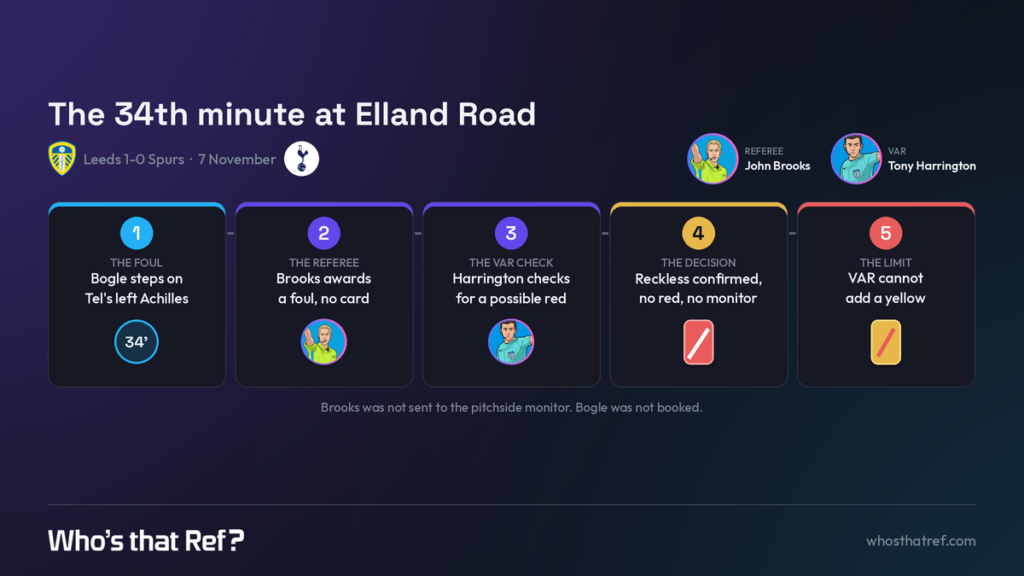
    In the 34th minute of Leeds’ 1-0 win over Tottenham at Elland Road on 7 November 2026, Bogle fouled Tel, stepping on his left Achilles. Referee John Brooks awarded a foul but did not show a card.

    VAR Tony Harrington checked for a possible red card. The Premier League Match Centre said the on-field decision of no red was checked and confirmed, and quoted Harrington:

    “I’m confirming the on-field decision of no red card. There’s a lack of speed going into the challenge and he’s stepping into the tackle. Confirming a reckless challenge.”

    The same wording appears in the Premier League’s Matchweek 10 VAR recap. Brooks was not sent to the pitchside monitor. Bogle was not booked for the incident.
    What does “reckless” actually mean?

    In football’s laws, reckless is not simply another word for a bad-looking tackle. It is a disciplinary category.

    IFAB’s Law 12 defines it as follows: “Reckless is when a player acts with disregard to the danger to, or consequences for, an opponent and must be cautioned.”

    A careless challenge needs no disciplinary sanction. A reckless challenge must be cautioned. Using excessive force, which includes endangering an opponent’s safety, requires a sending-off.
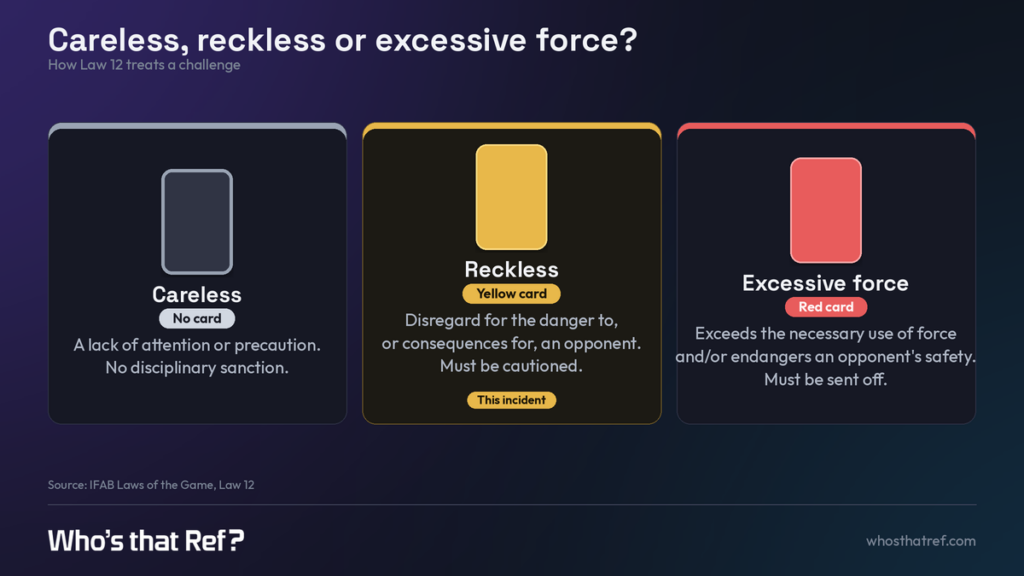
    That explains the frustration. The description supporters heard pointed towards a booking, but the outcome was no card.

    Why couldn’t VAR simply tell Brooks to book him?

    VAR is not a second referee with permission to correct every missed decision.

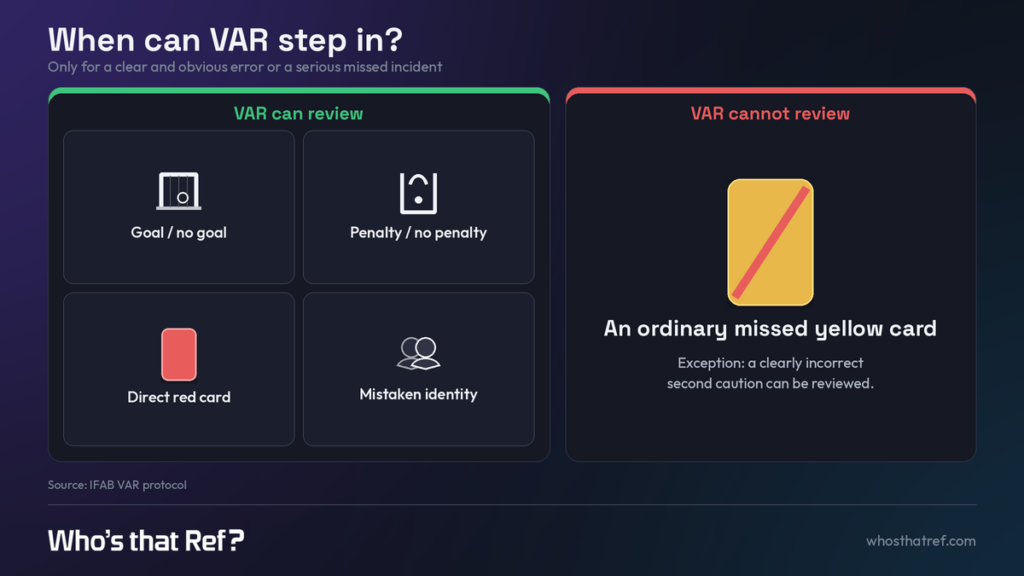
    In this incident, Harrington was checking whether the challenge warranted a direct red card. As BBC Sport’s analysis noted, a reckless challenge is a yellow card, but VAR could not intervene merely to advise that Bogle should be booked.

    That sits with the IFAB VAR protocol: VAR may assist only for a clear and obvious error or serious missed incident in relation to a goal, a penalty, a red card (not an ordinary missed caution) or mistaken identity.

    Once Harrington judged that the no-red decision should stand, the check did not become a separate review of whether Brooks had missed an ordinary caution.

    That does not make a reckless challenge a no-card offence. It means the on-field referee’s disciplinary decision and VAR’s power to intervene operate within different limits.

    Can a VAR review ever end with a yellow card?

    Yes. Saying “VAR can never lead to a yellow” would be misleading.

    The IFAB VAR protocol includes a specific example: VAR recommends an on-field review for a possible red-card challenge, but the referee watches the footage and decides it was only cautionable. The referee must then show yellow.

    The important distinction is why the review was initiated. A legitimate possible-red review can end in a caution. VAR cannot manufacture that review simply to correct a missed ordinary booking.

    Bogle’s incident did not reach that on-field review stage.
    Does that settle whether it should have been red?

    No. Explaining the process is not the same as endorsing the assessment.

    Supporters can still question whether the contact endangered Tel’s safety and whether Harrington should have recommended a monitor review. The official explanation tells us why the decision stood; it does not remove the debate.

    Nor should a still image or slow-motion clip be treated as the whole assessment. The protocol distinguishes identifying the point of contact from judging the intensity of a challenge, for which normal speed matters.

    The question worth asking

    The most useful debate is not simply “Why didn’t VAR give a yellow?” It is whether the possible-red decision was assessed correctly, and whether football wants VAR’s remit expanded to correct missed cautions.

    Those are different discussions. Keeping them separate makes it easier to challenge a decision without confusing who was responsible for it.

    At Who’s That Ref?, that distinction matters: the referee and the VAR do different jobs, even when both are involved in the same incident.
  • 14 games, no wins: Everton’s John Brooks record heads to St James’ Park

    14 games, no wins: Everton’s John Brooks record heads to St James’ Park

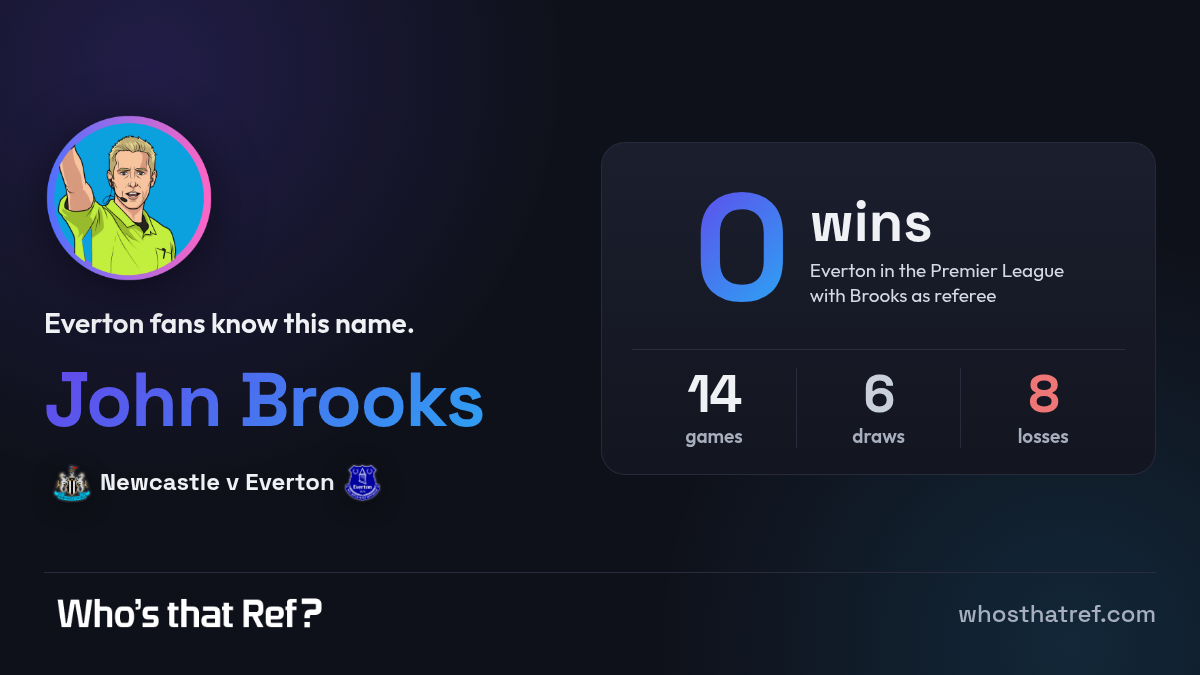
    John Brooks referees Newcastle v Everton on Monday night. Everton have never won a Premier League game with him as the man in the middle, and on our data he is the least favourable official in their history.

    Newcastle v Everton, St James’ Park, Monday 2 November, 8pm UK time. Referee: John Brooks. VAR: Paul Howard.

    The number every Everton fan will be talking about
    Fourteen games. No wins.

    That is Everton’s Premier League record when John Brooks has been the on-field referee, going back to the start of our data in the 2021/22 season. Of those 14 games, six have been draws and eight have been defeats.

    On Monday night he takes charge of Newcastle v Everton, so the run will either go on or finally end at St James’ Park.

    The full Premier League record

    Across those 14 games with Brooks as referee, Everton have:

    • won 0
    • drawn 6
    • lost 8
    • scored 11 goals
    • conceded 27 goals

    The draws include goalless games away at Fulham and Crystal Palace and a 2-2 at Nottingham Forest. The defeats include a 4-0 loss at Old Trafford in December 2024 and a 3-1 home loss to Sunderland in May 2026.

    Last time out


    The most recent of those 14 games was only two months ago. Everton hosted Manchester United at the Hill Dickinson Stadium on 6 September and twice fell behind, to goals from Bryan Mbeumo and Benjamin Sesko. Tyrique George levelled the first time, and Ainsley Maitland-Niles curled in a stoppage-time equaliser on his debut to make it 2-2.

    It was a point rescued at the death, and it kept the record at no wins.

    Where Brooks ranks for Everton


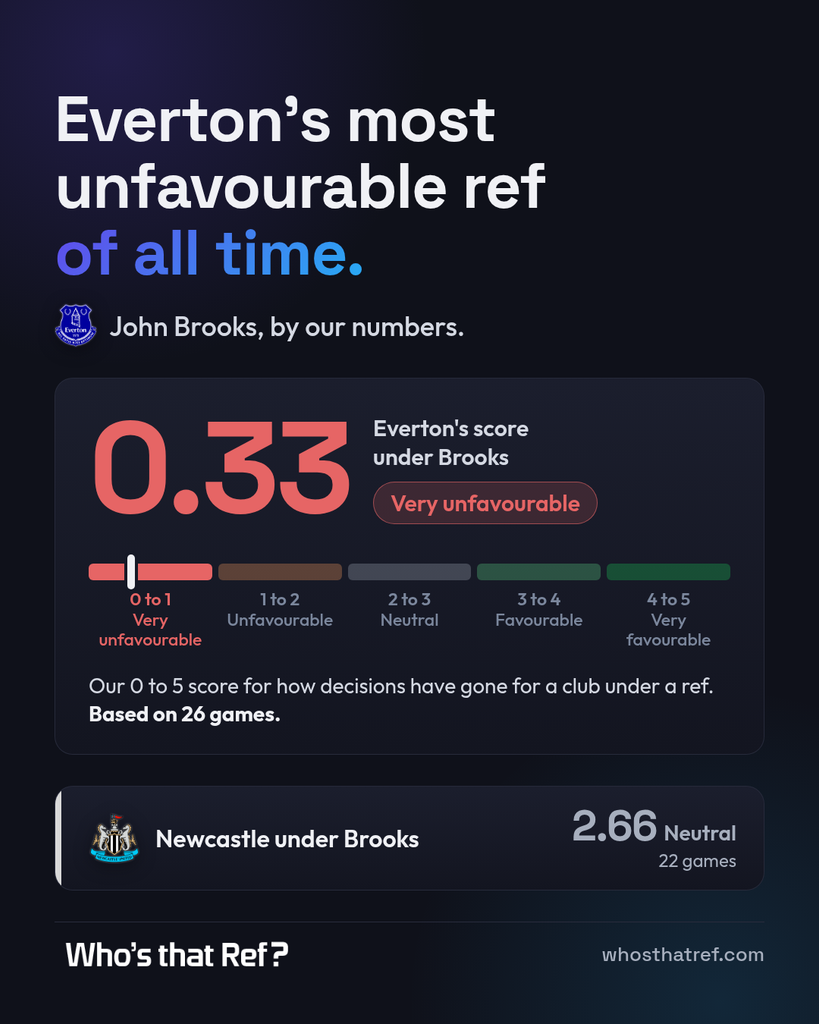
    On whosthatref.com, every official gets a Ref Performance Score, or RPS, for each club. In plain words, it is our 0 to 5 score for how decisions have gone for a club under a ref. It looks at win rate, goal difference and cards, compared with league averages, and it is adjusted for major decisions we have tracked since 2024/25. A score of 2.5 is neutral.

    Here is how to read it:

    • 0 to 1: very unfavourable
    • 1 to 2: unfavourable
    • 2 to 3: neutral
    • 3 to 4: favourable
    • 4 to 5: very favourable

    For Everton, John Brooks scores 0.33. That puts him in the very unfavourable band and makes him the lowest-rated of all 36 officials we track for Everton. Chris Kavanagh is next on 0.40.

    This score uses a wider sample than the 14-game record above. It covers 26 Premier League games where Brooks was involved with Everton, either as referee (14 games) or as VAR (12 games). Everton have won 4 of those 26 games (15%), scoring 20 and conceding 44. All four wins came in games where Brooks was on VAR duty rather than refereeing.

    RPS measures patterns in results, not intent. A low score does not mean a referee is against a club. It simply shows how things have gone for that club when he has been involved.

    The Newcastle contrast


    The picture is very different for the home side. Newcastle have played 22 games with Brooks involved and have won half of them (50%). Their RPS with him is 2.66, which sits in the neutral band. Their results under him are broadly in line with their results under everyone else.

    So one side comes into Monday with a neutral record under this referee. The other has a 14-game wait for a Premier League win under him.

    Who is on VAR?


    The VAR is Paul Howard, with Stuart Burt as assistant VAR. It is the same referee and VAR pairing as that 2-2 with Manchester United in September.

    Here is what Howard’s record shows so far.

    With Everton (7 Premier League games): Everton have won 3, drawn 2 and lost 2, scoring 11 and conceding 8. His RPS for Everton is 2.11, which is neutral. The most memorable VAR check of his with Everton came at Old Trafford in November 2025. Idrissa Gueye was shown a straight red card by referee Tony Harrington for slapping his own team-mate Michael Keane, and Howard checked and confirmed it as a “clear strike to the face”. Everton still won 1-0 with ten men.

    With Newcastle (4 Premier League games): Newcastle have won 2 and lost 2. His RPS for them is 2.77, also neutral, though four games is a small sample and should be treated with caution. His busiest night with them came against Burnley at St James’ Park in December 2025. He sent referee Stuart Attwell to the pitchside monitor twice, and both checks ended in handball penalties, one for each side. Newcastle won 2-1.

    What his record shows: with both clubs, Howard’s numbers sit in the neutral band. On our data, Monday’s story is far more about the referee than about the VAR.

    Explore the numbers


    You can see Everton’s full game-by-game history under John Brooks, along with every other official, at whosthatref.com/team/everton/referee/john-brooks. You can also look up Brooks at whosthatref.com/referee/john-brooks and Paul Howard at whosthatref.com/referee/paul-howard.

  • Everton Pre-Assists 2025/26: The Stat Nobody Talks About

    Everton Pre-Assists 2025/26: The Stat Nobody Talks About

    Assists get the credit. But what about the pass before the assist?

    Pre-assists are one of those football stats that barely get talked about. Which is strange, because they tell you something that most stats don’t. Expected goals tells you about shot quality. Assists tell you who played the final ball. But pre-assists tell you who started it. Who made the assist possible in the first place.

    What even is a pre-assist?

    A pre-assist is the final intentional completed pass to the player who records the assist, within the same uninterrupted attacking phase of play. The rules matter here. There can be no turnover, no stoppage, no major defensive reset between the pre-assist and the goal. The chain has to be clean and direct. If possession is lost and regained, the sequence resets. If play stops, the sequence resets. Only the pass that directly sets up the assister, within the same flowing move, qualifies.

    It sounds simple. In practice, manually logging every Everton goal this season and tracing each sequence back further is time consuming. But that’s what I’ve done.

    What the data shows:

    Out of 46 goals in 36 games, 23 involved a qualifying pre-assist. Just over half of Everton’s goals this season had a traceable, direct pass before the assist that met all the inclusion criteria.

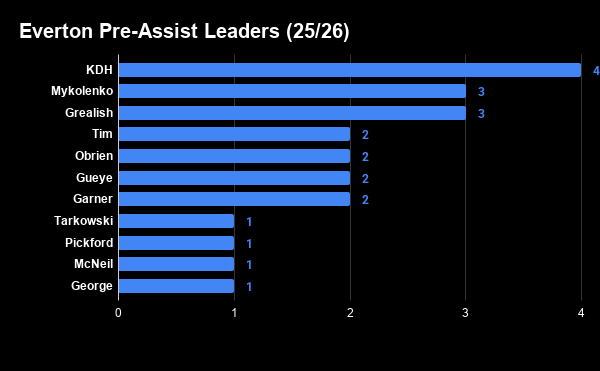
    The leading pre-assister is Kiernan Dewsbury-Hall with 4. Grealish and Mykolenko are joint second with 3 each.

    That Mykolenko figure is the one that jumps out. As an Everton fan who has watched him receive a lot of criticism this season, seeing him sit alongside Grealish in this list is genuinely surprising, in a good way. A left back contributing to the start of goal sequences at the same rate as one of the club’s most creative attackers is not something you would ever find in a standard stats breakdown. Pre-assists are exactly the kind of metric that surfaces players who do important work without ever getting the recognition for it. Mykolenko is a good example of that. Grealish is also a potential summer signing and this is one of the stats that support why we should consider it.

    Further down, Tim, Obrien, Gueye and Garner all sit on 2. Tarkowski, Pickford, McNeil and George each have 1. The fact that Pickford and Tarkowski appear at all is a reminder that pre-assist sequences can start from deep. A goalkeeper’s distribution or a centre back’s long pass can be the beginning of a goal chain even if it rarely gets framed that way. Image credit: BBC Sport

    The pairings:

    Looking at which players combine most often in pre-assist sequences adds another layer. Mykolenko to Grealish, KDH to Garner, and Gueye to Grealish are the only pairings that appear more than once across the whole season. Two of the three most frequent combinations end with Grealish receiving the pre-assist pass. That tells you where Everton’s attacking patterns are most concentrated. The left side, through Grealish, is where a significant proportion of goal-scoring moves begin to take shape. This should speak volumes considering he’s been injured since mid January.

    The KDH to Garner combination is interesting for a different reason. Both players are central midfielders. That pairing appearing twice suggests Everton are also building through the middle with some regularity, even if the left side dominates the picture overall.

    How Everton are building goals:

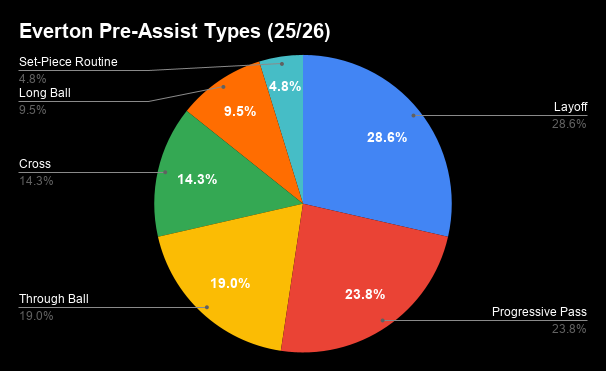
    The pass type breakdown is worth spending a moment on. Nearly 29% of pre-assists are layoffs, the simplest pass in football. Almost 24% are progressive passes that move the ball significantly further up the pitch. Through balls account for another 19%, crosses for 14%.

    What that distribution suggests is that Everton are not building goals through elaborate or high-risk passing. The most common pre-assist type is a ball played back or sideways to create a better angle or release a teammate. The second most common is a direct forward pass that advances play quickly. Everton are moving the ball simply and effectively in the phases that lead to goals, even when the goals themselves might look complicated.

    Why this matters:

    Standard football statistics reward the end product. Goals, assists, shots on target. They tell you who finished the move. Pre-assists ask a different question: who made the move possible?

    Some players show up in every stat. Pre-assists find the ones who don’t. And for a club like Everton, where certain players have carried criticism all season, it’s worth knowing which of those players are actually showing up in the data when it counts.

    This is part of an ongoing set of personal projects I’ve been building alongside Who’s That Ref?, all sitting at the intersection of football and data. If you work in the industry and want to connect, you can find me on https://www.linkedin.com/in/laurachloemadden/.

  • I Built Something. Then Fans Made It Real.

    I Built Something. Then Fans Made It Real.

    I launched Who’s That Ref? at the end of March and genuinely had no idea what to expect. Building something is one thing. People actually using it is another.

    In the first few matchweeks alone, the site had over 1,500 page visits. The Blue Room, an Everton podcast and pre-match show, picked it up and mentioned it twice to their audience. Fan channels from across the league started sharing it too. The Turfcast Podcast, Wolves Fancast, the 1865 Nottingham Forest Podcast, and others. By the end of those first few weeks the content had reached around 82,000 impressions on Twitter, entirely through fans sharing it with other fans. Every account that shared it, I’m genuinely grateful for.

    What struck me wasn’t the numbers. It was what people did with the site once they were on it.

    Fans weren’t just looking up their club. They were looking up their rivals. Comparing scores. Arguing about whether the methodology was right. Pushing back on results that didn’t match what they expected. One group of fans would find a low RPS and take it as confirmation of everything they’d suspected for years. Another set of fans from the same club would find the same score and question the whole premise.

    That’s exactly what the site is supposed to do. Not hand people a verdict. Give them something real to have the argument with.

    I’m a fan first. I just happen to be more interested in what the data says than most. That’s what Who’s That Ref? is – a fan’s attempt to bring some structure to a conversation football supporters have been having for as long as the game has had referees. The goal was never to build something clinical or authoritative. It was to build something useful, something that gives fans a better version of the argument they’re already having.

    They just hadn’t had anywhere to look before.

    https://whosthatref.com

  • Why I Built Whos that Ref?

    Why I Built Whos that Ref?

    I’m a lifelong Everton fan. I’ve spent more Saturday afternoons than I can count shouting at referees, or at least at the television showing me one. “That was never a foul.” “How has VAR not looked at that?” “Who even is this ref?” “Are they always this bad for us?”

    Those questions never went away. And eventually I started wondering whether the answers were actually out there, just not in one place.

    The data existed. Premier League match records, card counts, results, major decisions. What didn’t exist was a tool that pulled it all together from the perspective of a specific club. Something that could tell an Everton fan, or a Spurs fan, or a Leeds fan, what their actual historical record looked like with any given official. Not a feeling. Not a pub argument. Numbers.

    So I built it.

    Who’s That Ref? is a free platform that tracks Premier League referee performance from every club’s point of view. Each referee and VAR official gets a Referee Performance Score, a 0 to 5 rating that combines historical match outcomes with real officiating decisions. Penalties, red cards, disallowed goals. The things that change games.

    The database behind it covers over 1,800 Premier League matches across five seasons, over 50 officials, 27 clubs, and over 160,000 historical data points. That took months to build. Every match verified manually, every major decision reviewed before it touched a score.”

    A score of 2.5 is neutral. Above that, historically good for your club. Below it, historically not. And before anyone asks: the RPS measures correlation, not causation. A low score doesn’t prove a referee has it in for your team. But it does mean something. The pattern of outcomes when they’re in charge hasn’t gone your way, and over enough matches, that’s worth paying attention to.

    The question the site answers is one every fan asks before every game. Who’s the ref? Who’s on VAR? What can we expect?

    Now you can actually look it up.

    whosthatref.com